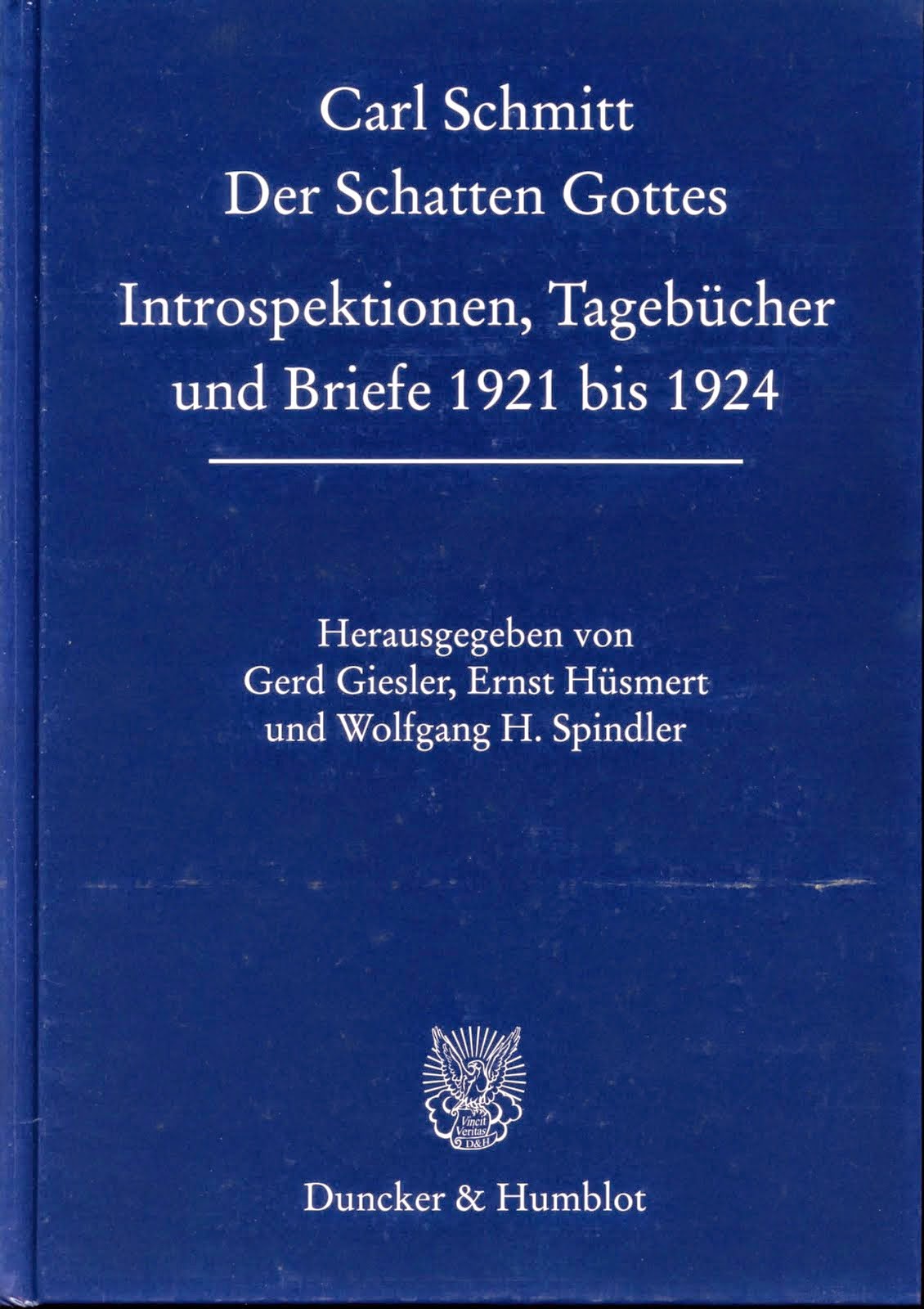
Uno degli scopi di questo blog è di promuovere un luogo di incontro virtuale fra quanti nel mondo si occupano scientificamente di Carl Schmitt. L’autore del blog ha una conoscenza (limitata) di italiano (lingua base), tedesco, inglese, francese, spagnolo. I testi qui riportati, per finalità didattiche, mai commerciali, indicando sempre la fonte, verranno immediatamente rimossi su richiesta degli aventi diritto.

12 maggio 2009

Letteratura italiana online su Carl Schmitt

Versione 1.0
Status: 12.5.09

Valgono per questa raccolta di pagine web italiane su Carl Schmitt le avvertenze già date per le altre sezioni. Si raccoglie ed ordina in una stessa pagina quanto si trova in rete, purché abbia un minimo di attinenza al tema Carl Schmitt. Si omettono mere citazioni di circostanza, senza nessun ancoraggio diretto al testo, come pure ci si astiene da interventi critici su ciò che qui si raccoglie. Per il Bibliografo è importante avere una panoramica della Wirkungsgeschichte del testo schmittiano, che sembra godere di una strana fortuna. Se per un verso le categorie schmittiane appaiono meglio rispondenti a dare una spiegazione non ideologica degli eventi tragici che si svolgono davanti ai nostri occhi, ultimo in ordine di tempo il massacro di Gaza seguito dalla disfatta politico-teologica del Vaticano, per un altro verso si accaniscono come non mai contro Carl Schmitt apologeti e propagandisti di regime. Ma non possiamo qui anticipare interventi critici che ci riserviamo di svolgere altrove. Si tratta qui soltanto di dare un’indicazione di massima sul carattere generale di ciò che si trova in rete: più interventi occasionali che non studi meditati. Noi però ci siamo qui proposti di fare la più ampia raccolta webgrafica possibile.

Sommario: 1. Laura Ferrante: «Jünger e Schmitt - Dialogo sulla modernità di Luigi Iannone». –

1. Laura Ferrante: «Jünger e Schmitt - Dialogo sulla modernità di Luigi Iannone». – Si tratta di una scheda bibliografica del libro di Luigi Iannone, Jünger e Schmitt. Dialogo sulla modernità. La modernità vista da due grandi pensatori tedeschi, uscito presso Armando Editore, Febbraio 2009, pagg. 142. La scheda di Laura Ferrante esce du l’Eco di Caserta.


CASERTA - Indagine su due tra i maggiori e più contestati pensatori del ’900. Ernst Jünger e Carl Schmitt, pur avendo fatto parte di quella grande corrente di pensiero anti-moderno che fu la Rivoluzione Conservatrice, hanno avuto come tratto comune l’aver anticipato le trasformazioni e le pulsioni del nuovo secolo. Questi due grandi pensatori tedeschi si sono lasciati alle spalle, almeno da un punto di vista dell’elaborazione teorica, l’esperienza traumatica dei conflitti mondiali e dei totalitarismi e, sin dal primo dopoguerra, sono andati oltre, intercettando le degenerazioni e le fughe in avanti della modernità.

Lo hanno fatto con stili diversi, pur percorrendo per larghi tratti sentieri paralleli. Un libro di Luigi Iannone, “Junger e Schmitt. Dialogo sulla modernita’’ (introduzione di Marcello Staglieno, Armando Editore), è un tentativo di riproporre in maniera non apologetica due tra i maggiori e più contestati pensatori del Novecento, e nello stesso tempo di vantare i loro meriti pionieristici: Schmitt è un pensatore che critica aspramente la modernità e lo fa sin dai suoi scritti giovanili; Jünger ha invece letto nella paura uno dei segnali di questo nostro tempo.

In queste pagine Iannone, studioso del pensiero conservatore e già autore di altri apprezzati contributi tra i quali ‘Giuseppe Prezzolini, intellettuale politicamente scorretto’ e ‘Storia, Europa e Modernità. Intervista ad Ernst Nolte’, fa notare come il senso di angoscia e l’accrescersi dell’ansia ma anche un sentimento di sradicamento, di cui ha parlato Simone Weil, tolgano all’uomo contemporaneo ogni certezza. I due giganti del pensiero hanno letto la modernità da postazioni diverse: Schmitt si è servito del linguaggio giuridico, Jünger utilizzando una nuova semantica. Entrambi consapevoli che ormai siamo costretti ad inseguire la Tecnica e che non la governiamo. L’uomo dunque che abdica di fronte al progresso. Questi due intellettuali sono riusciti a leggere in controluce le prospettive del mondo moderno, senza l’imposizione di un metodo rigoroso, almeno per quanto riguarda Junger, ma grazie a un ventaglio di variazioni ideologiche.

Torna al Sommario.

18 aprile 2009

Si è spento Giano Accame.


La prima notizia mi è neppure 24 ore dopo quella della morte di Franco Volpi, sempre dalla stessa fonte, da Carlo Lo Re. Il colpo è stato molto più duro. Mentre con Franco Volpi avevo rari contatti telefonici, sempre cordiali, di Giano avevo una frequentazione trentennale periodicamente rinnovata in occasioni varie, anche andandolo a trovare a casa, dove le ultime volte andai a ritirare collezioni di riviste tedesche, che aveva deciso di regalarmi. Fra queste anche Criticón, dove si trovavavano gli originali di articoli di Piet Tommissen e Günther Krauss, da me tradotti in italiano e resi disponibili in questo blog sia nel testo tedesco che nella mia tradizione italiana. Giano Accame andò a trovare Carl Schmitt nel 1954, quando io avevo quattro anni e non avevo certo sentito mai parlare di Schmitt. Per questo autore Giano ebbe sempre interesse ed attenzione e fu nel suo nome che intorno al 1980 nacque la nostra amicizia. Come già per Volpi, questa non è e non vuole essere un necrologia. Mi sto lasciando andare sull’onda dei ricordi, poco prima di uscire di casa per andare a Santa Maria della Consolazione, la chiesa nei pressi del Campidoglio, dove alle 10.30 inizierà la funzione religiosa.

In questi giorni si è tentato di tracciare un quadro della figura di Giano Accame. Di certo sarà utile uno studio su Giano che dia le date della sua vita, i titoli dei suoi libri, la sua attività di giornalista, il suo impegno politico, e così via. Ma gli amici possono attingere ai ricordi diretti dell’uomo ed alla sua parola viva. Per me Giano era una miniera di informazioni e di giudizi su uomini ed eventi. Anche negli ultimi anni era cresciuto il rispetto verso come il più ragguardevole intellettuale della destra italiana, l’uomo è stato non poco contrastato e mi vengono in mente alcuni episodi, cui non voglio adesso accennare nel momento della morte e e mentre mi accingo ad uscire di casa per rendere l’estremo saluto all’amico scomparso. Dopo la funzione, partirà per il suo ultimo viaggio, in Luano, il suo paese ligure, dove era nato e dove trascorreva l’estate, come io la trascorrevo al mio paese, nell’estrema Calabria. Da qui gli portavo bottiglie di Grappa che lui da intenditore gradiva. Non pensai mai di fargli una visita in Liguria, ma penso che adesso in Liguria ci andrò ogni tanto per soffermarmi in raccoglimento sulla sua tomba, come mi è capitato di recente con Aldo Moro, altra figura per me indimenticabile.

Torno adesso dalla cerimonia funebre e non voglio indugiare a scrivere alcune righe nell’immediatezza del momento. Dopo, con la riflessione, non saranno più le stesse. Un amico che ho incontrato mi ha molto garbatamente ed impercettibilmente fatto notare la mai propensione alla polemica. Si parlava di Fini, un politico che mi deluso, come del resto anche Alemanno. Io, lui ed altri ci siamo ritrovato per dare l’estremo saluto ad una persona che ci era cara, anche se diversamente cara. Finché l’amico Giano era vivo, non avevo mai pensato a lui come ad una persona che si dovesse studiare, come a scuola. Ed invece adesso penso che in qualche modo mi devo riappropriare di tutti aspetti e momenti della complessa personalità di Giano, che non avevo mai curato. Era presente il “primo cittadino”, cioè il Sindaco Gianni Alemanno che ha parlato tracciando un profilo politico e dando una sua valutazione della posizione politica dell’«intellettuale» scomparso, punto di riferimento di tutta la destra italiana. La mia amicizia con Giano si è sempre mantenuta nell’alveo degli interessi schimittiani. Fui io che feci incontrare in un ristorante calabrese Giano con Giacomo Marramao. Entrambi desideravano da tempo fare conoscenza. Nell’ambito della politica della destra Accame è stato sempre qualcosa di controverso, ovvero fonte di dibattito. E sembra che lo sia ancora. Al termine della cerimonia, mentre la bara lasciava la chiesa, per scendere la gradinata, un folto numero di persona lo ha salutato con il saluto fascista al grido di “Camerati!”. Anche questo era Giano, che non ha mai rinnegato la sua adesione, a 17 anni, alla Repubblica Sociale Italiana, che per lui era l’Italia rimasta dopo la disfatta, l’onore da conservare e difendere. Ma questo è un discorso. È il lascito che sento di ricevere da Giano. Adesso che lui non è più fra noi è un pietoso e doveroso onere da parte degli amici ricostruirne tutto il percorso della sua vita, dei suoi scritti, delle sue “posizioni”, dei suoi “concetti”.

16 aprile 2009

Una perdita per la cultura italiana: la morte di Franco Volpi


La notizia mi è giunta ieri, per posta elettronica, da Carlo Lo Re. Non ci volevo credere, speravo si trattasse di un’omonimia e non del Franco Volpi che conoscevo, ma poi andando al leggere l’intero testo del blog di Lo Re e vedendo anche la foto ho dovuto convincermi che si trattava proprio di Franco. Non posso dire di avere avuto con lui una grande frequentazione e questo non è e non vuole essere un necrologio. Avevo conosciuto Franco Volpi in Germania ad una serie di Seminari organizzati dall’Istituto filosofico marottiano. Leggo che era nato nel 1952, due anni più giovane di me, dunque, ma era nel frattempo passato a ordinario di storia della filosofia. Non ho mai avuto nessunissima invidia per la carriera che lui e altri amici nel frattempo hanno fatto, mentre io sono rimasto al palo: ben meritata! Soprattutto, non per questo cambiavano i nostri personali rapporti. Fuori dai seminari tedeschi non ricordo di averlo mai incontrato, lui abitava a Padova ed io a Roma. Non capitava perciò di incontrarsi per strada, per fare una passeggiata insieme, come mi accadeva spesso con Antimo Negri, con il quale lungo il viale Regina Margherita facevamo esercizio di maldicenza su tutta la cultura italiana. Non si risparmiava nessuno e dopo ci sentivamo meglio. Scherzi a parte, ho un caro, carissimo ricordo di Franco Volpi, la cui voce al telefono conservava sempre la stessa freschezza e disponibilità della prima volta che ci conoscemmo. Lui lavorava con Adelphi io con Giuffrè. Si era anche prestato per dare copertura giornalistica al convegno che io avevo organizzato in Roma su Carl Schmitt. Ci sentivamo, in genere, per risolvere pasticci editoriali e da lui apprendevo di cose che non divulgavo e che potevano ben andare in una rubrica una volta esistente su L’Espresso: I segreti degli editori. Non so se esiste ancora questa rubrica, perché non leggo più da parecchi anni L’Espresso. Ma alcuni di questi segreti andrebbero raccontati anche per iscritto e non solo a voce, come faccio con gli amici fidati. Negli ultimi tempi lo avevo cercato con insistenza al numero di telefono che avevo, lo stesso che altri pure avevano. Non rispondeva nessuno ed avevo supposto o che avesse cambiato casa o che il numero non fosse più quello.

Il pasticcio ultimo era la contemporanea uscita, quasi nello stesso giorno, della “Tirannia dei valori” in edizione Adelphi e in edizione Morcelliana con lieve e concorrenziale differenza di prezzo di copertina. Dopo la morte del prof. Kaiser la gestione dei diritti di Schmitt ed il piano di edizioni versa nel più completo caos ed io non so a quale interlocutore potermi rivolgere. Risponde una signora alla quale le mie ultime parole sono state: Ich bin mude. Contavo di risolvere il problema non solo della “Tirannia dei valori”, ma altri in corso se avessi potuto parlare con Franco, come già altre volte. Rimandavo ogni volta all’occasione in cui lo avessi incontrato o qualcuno avesse potuto darmi un nuovo e diverso recapito. Giunge però a tradimento la morte prematura. Non la malattia ci ha tolto Franco Volpi, ma – spero di non sembrare irriverente – “mentre passeggiava in bici”, secondo quanto leggo da Carlo Lo Re. Non ci si riesce mai ad abituare all’idea della morte di una persona cara, dei genitori, di un parente, di un amico. Non essendo noi eterni in una serie di casi ci si deve tuttavia rassegnare, ma in altri non si accetta il fatto ineluttabile della perdita. È il caso di Franco Volpi, di cui non ricordo se una volta vidi appena la moglie. Non conosco nessuno dei suoi familiari a cui far giungere le mie condoglianze. Ripeto: questo non è un necrologio. Esprimo, in questo inizio di giornata, il mio rimpianto per l’amico perso. Più tardi andrò a fare lezione, iniziando dopo Pasqua la parte del corso dedicata quest’anno alla Tirannia dei valori. Inizierò parlando agli studenti di Franco Volpi, ricordandone la figura per come io l’ho conosciuta e soprattutto ricordando la gentilezza dell’uomo, la grande cultura, la disponibilità costante e spontanea, l’amabilità, la signorilità.

02 aprile 2009

Letteratura online su Carl Schmitt in lingua spagnola

Versione 1.1
Status: 6.4.09

Vale anche per la letteratura spagnola qui raccolta quanto detto per le altre letterature divise per aree linguistiche. Aggiungiamo che la segnalazione dei links ci giunge attraverso una google-alert, dove l’arretrato da smaltire è alquanto abbondante. Seguiremo in linea di massima un ordine crononolgico a ritroso: dal più recente al meno recente. Esaurita questa fonte di notizie passeremo ad esplorare la rete attraverso i motori di ricerca. In ultimo, se il materiale risulterà abbondante, cercheremo di governarlo con nuovi blogs tematici plurilingue. Non mi stanco di ripetere che in fase di raccolta del materiale devo necessariamente astenermi da ogni giudizio e valutazione critica. La referenza che fornisco è di natura prettamente bibliografica. Ciò non toglie che i lettori del post possono dare loro i giudizi che meglio credono sul contenuto degli articoli. Valgono in questo caso le regole generali della netiquette. In genere, eviterò anche di partecipare al dibattito e alle discussioni che ospiterò secondo i normali criteri di pubblicazione.

Sommario: 1. Juan Sánchez Torrón: “Refrendo electoral a poderes inseparados”. –

Simboli: A = Articolo;

1. Juan Sánchez Torrón: “Referendo electoral a poderes inseparados”. A – L’articolo non è firmato e costituisce probabilmente un editoriale. Esce con data Miércoles 18 de marzzo de 2009 su sito laopinionecoruña.es. Deve trattarsi dell’edizione online del giornale su carta stampata La Opinión A Coruña. – L’articolo che qui appare non firmato è però di Juan Sánchez Torrón e lo si trova anche su Rebelión del 20 marzo 2009. Io ne ho avuto la sua prima notizia attaraverso una Google Alert. Ringrazio l’Autore per la segnalazione.

*
laopinionecoruna.es
18 de marzo de 2009


1. Parlamentarismo. – En su Teoría de la Constitución, Carl Schmitt describe la evolución del parlamentarismo desde una situación de partida en la que: “El Parlamento representa a toda la nación como tal y emite por ello, en discusión y acuerdo públicos, leyes, es decir, normas generales”. Para esta situación de partida, “la publicidad de las deliberaciones es el nervio de todo el sistema”, y “se garantiza mediante prescripciones de la ley constitucional”. Así lo sancionaba la Constitución alemana de la República de Weimar, en su artículo 29: “El Reichstag delibera públicamente”. Pero el fundamento racionalista del parlamentarismo, según el cual de la discusión, o como dicen ridículamente, del “contraste de pareceres”, surgiría la verdad, ha quedado por completo desacreditado por la práctica moderna de las partidocracias, que no escapaba, ya en 1928, a la aguda mirada del jurista alemán: “El Parlamento, en la mayor parte de los Estados, no es ya hoy un lugar de controversia racional donde existe la posibilidad de que una parte de los diputados convenza a la otra y el acuerdo de la Asamblea pública en pleno sea el resultado del debate (…). La posición del diputado se encuentra fijada por el partido (…). Las fracciones se enfrentan unas a otras con una fuerza rigurosamente calculada por el número de mandatos (…). Las negociaciones en el seno del Parlamento, o fuera del Parlamento, en las llamadas conferencias interfraccionales, no son discusiones sino negociaciones; la discusión oral sirve aquí a la finalidad de un cálculo recíproco de la agrupación de fuerzas e intereses. El privilegio de la libertad de discurso (inviolabilidad) perdió con esto sus supuestos (…). El Parlamento se convierte en una especie de autoridad que decide en deliberación secreta y que anuncia el resultado del acuerdo en forma de votación en una sesión pública”.

Si el carácter público de las deliberaciones asamblearias se entiende como componente sustancial de la democracia -por muchas definiciones que admita un término tan propenso a confusiones y manipulaciones, no parece que en ese aspecto pueda haber dudas- entonces la práctica moderna del parlamentarismo, que permite vulnerar la exigencia de publicidad, mediante las oscuras transacciones del consenso a puerta cerrada entre los jefes de las respectivas facciones enfrentadas, queda, por vía negativa, perfectamente asimilada a un procedimiento dictatorial, reforzado, en el mejor de los casos, por la aclamación de las masas: clamor siempre necesario para una dictadura.

2. Régimen de listas. – Es necesario, sin embargo, unir al apunte de Schmitt una cuestión sustancial como la del sistema electoral, muy directamente relacionada con la tara que aquí se aborda. La discusión sobre la conveniencia de adoptar un sistema u otro parece moverse dentro de las diferencias cuantitativas entre sistemas de listas, cerradas o abiertas, es decir, sistemas proporcionales: los partidos políticos han logrado centrar el foco de la opinión pública en la cuestión de la mayor o menor proporcionalidad del sistema electoral, renunciando a poner en entredicho la idea misma de proporcionalidad como el verdadero núcleo del problema. Ya Max Weber señaló que “el sistema de representación proporcional tendrá como efecto la creación de un parlamento apolítico sin espacio para el liderazgo”. Dicho sistema convierte indefectiblemente a los diputados en delegados de los partidos políticos a sueldo del Estado, dispuestos a obedecer las instrucciones cursadas por los respectivos jefes de filas, es decir, dispuestos a sujetarse a la tan encarecida “disciplina de partido”, que en las democracias anglosajonas, es decir, aquellas que desconocen el sistema proporcional y se han decantado por el sistema mayoritario uninominal de distritos electorales, sería una completa aberración.

Sería ocioso, a este respecto, comparar lo acontecido en Reino Unido y España en la gestión de la última guerra de los Estados Unidos contra Irak: el abandono al que un grupo de diputados del Partido Laborista sometió a Tony Blair aquí sería impensable. En lugar de ello, los diputados del Partido Popular se plegaron con absoluta fidelidad a las instrucciones del presidente José María Aznar mientras decenas de miles de manifestantes invadían las calles: los parlamentarios sabían a quien debían obediencia. Disciplina de voto que, dicho sea de paso, solo puede reforzar el descontrol del poder y la inseparación entre los poderes Ejecutivo y Legislativo, tal y como, por lo demás, es característica definitoria del parlamentarismo.

3. Eleciones autonómicas. – En la fiesta democrática que acaba de transcurrir con total normalidad, y en la que, conforme a la propaganda oficial, vascos y gallegos han vuelto a dar un notable ejemplo de “madurez” y “participación ciudadana”, los electores han ido a depositar su “confianza” en la opción que han estimado oportuna. Confianza que, a su vez, será sesudamente utilizada por los partidos políticos con representación en las cámaras. Nadie lo explicaba mejor que el presidente del Gobierno español en su última entrevista en Antena 3, en referencia a la situación en el Pais Vasco: “El Partido Socialista decidirá su política de pactos una vez que se conozca el resultado electoral”. Lo cual no significa otra cosa más que el Partido Socialista y, por supuesto, todos los demás partidos han reclamado la confianza previa de los electores para acudir bien pertrechados de munición al proceso de negociaciones que se avecina.

No se trata de limitar las opciones de antemano, pues eso exigiría un compromiso firme ante los votantes con los principios defendidos en la campaña electoral: estos principios son ya bastante elásticos como para preparar el terreno del consenso que está por venir. Tal grado de transparencia sería radicalmente incompatible con el “normal funcionamiento de las instituciones democráticas” por el cual, según el presidente, hay que esperar a conocer la composición de la Cámara para que los electores sepan como los partidos van a administrar la confianza otorgada.

Sería, sin embargo, mucho más preciso, que donde dijo “instituciones democráticas” hubiera dicho “parlamentarismo partidocrático”: sólo en un régimen en el cual los diputados electos del Poder Legislativo nombran al Poder Ejecutivo siguiendo las instrucciones cursadas por los jefes de filas cabe este atropello por el cual los partidos se arrogan y usurpan a la ciudadanía la facultad de elegir y deponer gobiernos de forma directa, sin sujetarse a la aprobación parlamentaria, como exigiría el más elemental principio de la separación de poderes.

Cuando algunos dirigentes se quejan del al parecer desmesurado poder alcanzado en el extinto “Gobierno bipartito” gallego por la tercera fuerza política del país, cuando sostienen incongruencias tales como que “lo democrático sería que gobernase la lista más votada” están haciendo un discurso presidencialista dentro de un régimen que no lo es; están apelando a una separación entre Ejecutivo y Legislativo inexistente. Los ciudadanos no votan para elegir gobierno alguno, sino para otorgar a los partidos políticos cuotas de poder en la cámara legislativa, que es la que, a su vez, designa al jefe de gobierno. Que, huelga decirlo, no tiene por qué ser el candidato de la lista más votada. Y una vez designado el Ejecutivo, el sujeto de tal designación, o sea el Legislativo, queda subsumido y fagocitado por aquel. “Si no hubiera monarca y se confiara el poder ejecutivo a cierto número de personas del cuerpo legislativo, la libertad no existiría, pues los dos poderes estarían unidos, ya que las mismas personas participarían en uno y otro”, sostiene Montesquieu.

El cierre apresurado de la comisión de investigación sobre el caso de los espías en la Asamblea de Madrid, por decisión del propio Gobierno investigado, ilustra bien el alcance y significado de las palabras de Montesquieu. Y si a ello se añade el hecho de que los pactos de gobierno no son competencia de los parlamentarios sino de sus jefes de filas, en negociaciones a puerta cerrada -y de lo cual sería un ejemplo paradigmático las reuniones entre socialistas y populares para el pacto de gobierno vasco-, a la ya aludida vulneración de la separación de poderes consustancial al parlamentarismo se une entonces el atropello que con tanta precisión describe Carl Schmitt: “Tan pronto como se produce el convencimiento de que en el marco de la actividad parlamentaria lo que se desenvuelve a la luz del día es sólo una formalidad vacía y las decisiones recaen a espaldas de lo público (…), el Parlamento ha dejado de ser representativo de la unidad política del pueblo”. En efecto, definiciones de democracia hay muchas. Pero allí donde no hay representación sino tan sólo confianza, refrendo o aclamación, empieza a ser terriblemente difícil distinguir la democracia de un régimen caudillista comandado por los jefes de los partidos.

Torna al Sommario.

Letteratura online su Carl Schmitt in lingua francese

Versione 1.0
Status: 2.4.09

Valgono gli stessi criteri e le stesse avvertenza che abbiamo espresso per le altre letterature online in lingua tedesca, inglese, latino-americana. Negli ultimi anni per la letteratura francese sembra notarsi un certo accanimento e livore antischmittiano nell’ottica di un’interpretazione ideologica e del nazismo e della questione ebraica. Osserviamo brevemente al riguardo che questa tendenza più che riguardare Schmitt riguarda le condizioni della cultura francese, dove un autentico clima di caccia alle streghe ha fortemente compromesso la libertà di pensiero e di ricerca. Come nel primo caso che segue ci limitiamo a fare degli estratti dal testo per le sole citazioni significative a Schmitt. Gli articoli che seguono una loro logica, estranea al contesto schmittiano, possono comunque essere letti nella loro interezza cliccando sul link del titolo del paragrafo. In questa fase di raccolta e censimento ci asteniamo da qualsiasi commento e intervento redazionale che non sia di carattere strettamente bibliografico. Eventuali illustrazioni hanno lo scopo di allegerire le colonne di testo e sono redazionali. Verranno rimosse immediatamente su richiesta degli aventi diritto. L’ordine di successione dei paragrafi è del tutto casuale. Si procederà alla raccolta sistematica di tutto il materiale che si riesce a reperire online. È possibile la riproduzione di articoli cartacei con il consenso o su richiesta degli autori, editori, aventi diritto. Ogni segnalazione da parte degli utenti è gradita. Ci scusiamo per alcune inserzioni pubblicitarie, non dipendenti dalla nostra volontà, che da qualche anno continuano a disturbare l’uso del sito. Abbiamo aderito da qualche giorno al programma Adsense sperando di eliminare in questo modo la precedente propaganda pirata, che però afflige solo questo blog fra i tanti da me curati. Un vero mistero.

Simboli: I = Interviste;

Sommario: 1. Mathieu Rigouste: “La notion d’«ennemi intérieur»”. –

1. Mathieu Rigouste: “La notion d’«ennemi intérieur»”. I – Con data Dimanche 29 mars 2009 sul sito Le Jura Libertaire con titolo L’Ennemi intérieur compare un’Intervista a Mathieu Rigouste «cercheur en sciences sociales», dove in un passo è citato Carl Schmitt. Viene di seguito dato questo estratto, mentre il testo integrale dell’intervista può lerggersi cliccando sul link del titolo.
*
Le Jura Libertaire
Dimanche, 29 mars 2009
L’Ennemi intérieur
di
Mathieu Rigouste

…Partout où il existe des formes d’autorité centralisée, on observe la désignation d’un personnage récurrent, venant d’ailleurs et qui importerait au cœur du groupe «sain» les germes du désordre. Purger l’ennemi intérieur est un principe anthropologique, cela permet aux dominants de dissuader les uns de se révolter, s’ils ne veulent pas finir comme bouc émissaire et de masquer les rapports de domination aux autres. La purge publique semble par ailleurs souder autour du chef protecteur autoproclamé les parties de la population effrayées. Des sociologues comme Alfred Schütz ou Georg Simmel ont observé l’existence de ce principe dans des groupes sociaux très différents, des anthropologues comme René Girard ont étudié la récurrence de la fonction de bouc émissaire dans les sociétés monothéistes et le juriste nazi Carl Schmitt en a fait le centre de sa conception de l’État moderne. Il concevait la toute jeune Cinquième République française, née en 1958 d’un coup d’État militaire censé sauver l’Empire face à la menace combinée des communistes et des colonisés insurgés, comme un modèle de souveraineté, le prototype d’un État contre-subversif œuvrant pour la purification de la société…

Torna al Sommario.

01 aprile 2009

Letteratura online su Carl Schmitt in lingua inglese

Versione 1.2
Status: 5.4.09

La lingua inglese ha una diffusione tale da rendere piuttosto problematica una ulteriore distinzione per aree geografiche, come abbiamo già fatto per la lingua spagnola distinguendo fra ciò che appare in Spagna e ciò che si pubblica negli altri paesi di lingua spagnola, cioè latino americani. Preferiamo qui raccogliere in un solo file tutto ciò che reperiamo in lingua inglese, seguendo qui un ordine cronologico inverso, indicativamente dalle cose più recenti alle meno recenti. Non potendo, per ragioni pratiche, sovvertire la successione numerica dei paragrafi, provvederemo in un secondo tempo ad una maggiore sistematicità del materiale raccolto, di cui è indicata sempre la fonte ed il link, ritenendo in questo modo di aver ottemperato ad elementari obblighi e sempre restando disponibili a rimovuere il testo su semplice richiesta degli aventi diritto. In fase di raccolta e di censimento dei testi, che devono avere un minimo di significatività ed attinenza alla figura e all’opera di Carl Schmitt, ci asteniamo da qualsiasi commento critico. La pubblicazione e rilevazione del testo in sé non comporta nessun giudizio. Le indicazioni che precedono il testo hanno mero carattere bibliografico. Riteniamo di fornire un servizio utile a noi stessi e alla generale comunità degli studiosi di Carl Schmitt, accedendo ad un tipo di letteratura che va guadagnando sempre più diffusione. Siamo grati ai Lettori che ci segnaleranno testi a noi sfuggiti o agli Autori che vorranno rendere accessibili e divulgabili loro testi disponibili solo su pubblicazioni cartacee. Infatti, non escludiamo di poter riunire in questo stesso file anche la letteratura solamente “cartacea”, purché ci pervenga la formale autorizzazione degli aventi diritto. Ciò vale per tutte le lingue in cui esce questa Bibliografia e Raccolta di testi.
Simboli: E = Estratti.

Sommario: 1. Giorgio Agamben: “The State of Emergency”. – 2. Michael Marder: “In the Name of the Law: Schmitt and the Metonymic Abuses of Legitimacy”. – 3. Israel Shamir: “The Tyranny of Liberalism”. –

1. Giorgio Agamben: “The State of Emergency”. E – Si tratta di un estratto di una conferenza di Giorgio Agamben, tenuta al centro Roland-Barthes (Université Paris VII, Denis-Diderot). Esce su un quotidiano pakistano: Daily Times. You right to now. A new voice for a new Pakistan, Saturday, March 21, 2009.

*

Daily Times,
A new voice for a new Pakistan
(Pakistan)
Saturday, March 21, 2009

PURPLE PATCH: The State of Emergency
— Giorgio Agamben
In his Political Theology (1922), Carl Schmitt (1888-1985) established the essential proximity between the state of emergency and sovereignty. But although his famous definition of the sovereign as “the one who can proclaim a state of emergency” has been commented on many times, we still lack a genuine theory of the state of emergency within public law. For legal theorists as well as legal historians it seems as if the problem would be more of a factual question than an authentic legal question.

The very definition of the term is complex, since it is situated at the limit of law and of politics. According to a widespread conception, the state of emergency would be situated at an “ambiguous and uncertain fringe at the intersection of the legal and the political,” and would constitute a “point of disequilibrium between public law and political fact.” The task of defining its limits is nevertheless nothing less than urgent. And, indeed, if the exceptional measures that characterize the state of emergency are the result of periods of political crisis, and if they for this very reason must be understood through the terrain of politics rather than through the legal or constitutional terrain, they find themselves in the paradoxical position of legal measures that cannot be understood from a legal point of view, and the state of emergency presents itself as the legal form of that which can have no legal form.

And, furthermore, if the sovereign exception is the original set-up through which law relates to life in order to include it in the very same gesture that suspends its own exercise, then a theory of the state of emergency would be the preliminary condition for an understanding of the bond between the living being and law. To lift the veil that covers this uncertain terrain between, on the one hand, public law and political fact, and on the other, legal order and life, is to grasp the significance of this difference, or presumed difference, between the political and the legal; and between law and life.

Among the elements that render a definition of the state of emergency thorny, we find the relationship it has to civil war, insurrection and the right to resist. And, in fact, since civil war is the opposite of the normal state, it tends to coalesce with the state of emergency, which becomes the immediate response of the State when faced with the gravest kind of internal conflict. In this way, the 20th century has produced a paradoxical phenomenon defined as “legal civil war.”

Let us look at the case of Nazi Germany. Just after Hitler came to power (or, to be more precise, just after he was offered power) he proclaimed, on February 28, 1933, the Decree for the Protection of the People and the State. This decree suspends all the articles in the Weimar Constitution maintaining individual liberties. Since this decree was never revoked, we can say that the entire Third Reich from a legal point of view was a twelve year-long state of emergency. And in this sense we can define modern totalitarianism as the institution, by way of a state of emergency, of a legal civil war that permits the elimination not only of political adversaries, but whole categories of the population that resist being integrated into the political system. Thus the intentional creation of a permanent state of emergency has become one of the most important measures of contemporary States, democracies included. And furthermore, it is not necessary that a state of emergency be declared in the technical sense of the term.

At least since Napoleon’s decree of December 24, 1811, French doctrine has opposed a “fictitious or political” state of siege in contradistinction to a military state of siege. In this context, English jurisprudence speaks of a “fancied emergency”; Nazi legal theorists spoke unconditionally of an “intentional state of emergency” in order to install the National Socialist State. During the world wars, the recourse to a state of emergency was spread to all the belligerent States. Today, in the face of the continuous progression of something that could be defined as a “global civil war,” the state of emergency tends more and more to present itself as the dominant paradigm of government in contemporary politics. Once the state of emergency has become the rule, there is a danger that this transformation of a provisional and exceptional measure into a technique of government will entail the loss of the traditional distinction between different forms of Constitution.

The basic significance of the state of emergency as an original structure through which law incorporates the living being — and, this, by suspending itself — has emerged with full clarity in the military order that the President of the United States issued on November 13, 2001. The issue was to subject non-citizens suspected of terrorist activities to special jurisdiction that would include “indefinite detention” and military tribunals. The U.S. Patriot Act of October 26, 2001, already authorized the Attorney General to detain every alien suspected of endangering national security. Nevertheless, within seven days, this alien had to either be expelled or accused of some crime. What was new in Bush’s order was that it radically eradicated the legal status of these individuals, and produced entities that could be neither named nor classified by the Law. Those Taliban captured in Afghanistan are not only excluded from the status as Prisoners of War defined by the Geneva Conventions, they do not correspond to any jurisdiction set by American law: neither prisoners nor accused, they are simply detainees, they are subjected to pure de facto sovereignty/to a detention that is indefinite not only in its temporal sense, but also in its nature, since it is outside of the law and of all forms of legal control. With the detainees at Guantamo Bay, naked life returns to its most extreme indetermination.

Giorgio Agamben is Professor of Philosophy at the University of Verona. This is excerpted from an extract from a lecture given at the Centre Roland-Barthes (Universite Paris VII, Denis-Diderot)

— Sent by Mehreen Zahra-Malik

Torna al Sommario.

2. Michael Marder: “In the Name of the Law: Schmitt and the Metonymic Abuses of Legitimacy”. A – Si tratta di un testo, presentato alla “2009 Telos Conference”, che appare sul sito online di Telos in data 4 febbraio 2009.

*
TELOSscope
February 4, 2009

In the Name of the Law:
Schmitt and the Metonymic Abuses of Legitimacy

by Michael Marder

This talk was presented at the 2009 Telos Conference.

A conflation of legality and legitimacy, brilliantly explored by Carl Schmitt, is the first of three essential confusions I term "the metonymic abuses of modernity." In a nutshell, I argue that, when it comes to the modern political order, one of its privileged parts always stands for the whole: bourgeois legality metonymically signifies legitimacy in general, constitutional law and the Rechtsstaat constitution denote the constitutional regime as such, and the state appears as the incarnation of the political. The rampant abuses of metonymy and synechdoche in modern political thought polemically raise a particular kind of legitimacy, a specific type of the constitution, and one of the loci of the political to the status and the dignity of the genus, in a way that de-legitimizes their rivals. Furthermore, in aligning the three metonymic abuses of modernity, I reconstruct the multi-layered edifice of contemporary politics and, at the same time, show how Schmitt chisels away its fixed and ossified building blocks. If legality, which usurps the place of legitimacy, is the most superficial, depersonalized, "dead" stratum, then the political (metonymized by a centralized state) is the most profound and animating source, defaced by everything that is predicated upon it. Finally, the metonymy of the constitution and constitutional law is the intermediate step between the state that does not merely have but is its constitution and the legitimacy assumed in keeping with the existing constitutional order.

Although legality may be justifiably understood as the lifeless and most depersonalized crust of the modern political edifice, Schmitt reminds us that the original anchoring of all legitimacy in legality served a highly specific and lively polemical intention: "'Legality' . . . has the meaning and purpose of making superfluous and negating [überflüssig zu machen und zu verneinen] the legitimacy of either the monarch or the people's plebiscitarian will."[1] A simple invocation of the term's historically situated and polemical origin dusts away the veneer of neutrality and universality that it has strategically adopted in the fight against the competing models of legitimacy and further augmented in the aftermath of its victory in this struggle. It points to the still smoldering cinders of a conflict—and, hence, of a political phenomenon—that has been naturalized not without the help of that victorious historiography which Benjamin so vividly depicts in his "Theses on the Philosophy of History."

This quick recourse to history should not give one the impression that the hegemony of legality is totally assured and univocal, or that historicization is a panacea against the metonymic abuses of modernity. If "the dominant concept of legitimacy today is in fact democratic" legality [2], then those regimes that do not follow this trend are proclaimed to be the illegal and illegitimate rogue states. But non-democratic political leaders of countries such as Russia and Zimbabwe grasp and, even, subscribe to the rules of the game as well as, if not better than, anyone else. They stage farcical elections coupled with the intimidation and suppression of their political opponents by means of brute force, consistently acting "in the name of the law," for nowadays not even the most autocratic head of state will admit to governing on the basis of his (most often, his) personal voluntas. Putin-Medvedev, Bush, and Mugabe can equally appeal to the legality of the process that got them "elected" and even disavow various forms of non-democratic legitimacy. They can declare their domestic opponents illegal to the point of "excluding them from the democratic homogeneity of the people,"[3] metonymically identifying the dubious majority they command not with their party, but with the state itself. With the main oppositional figures, including Kasparov and Kas'yanov, legally barred from participating in the most recent Russian presidential elections (and, in the case of Kasparov, put in jail), the Russian state officials seem to have taken a page from Schmitt's critique of the purely legislative state, in which the majority can "treat partisan opponents like common criminals, who are then perhaps reduced to kicking their boots against the locked door."[4] Similarly, last year, the political crisis in Zimbabwe saw Mugabe unwilling to cancel the second round of the a priori rigged elections after his sole opponent, Tsvingarai, had withdrawn from the race.

The subsequent emphasis placed on "the rule of law" as the centerpiece of legality is misguided and absurd if one takes it literally. Time and again, Schmitt points out that "laws do not rule. . . . Whoever exercises power and government acts 'on the basis of law' or 'in the name of the law' [ 'auf Grund eines Gesetzes' oder 'in Namen des Gesetzes']."[5] A naïve belief in the fact that the laws rule is tantamount to other instances of not taking figuratively, as a trope or as a metonymy, the expressions "the Crown rules" or "the Bench decides." Reifying machinations notwithstanding, the law does not have any inherent capacity for self-interpretation, just as the bench, on which a judge sits, lacks the ability to proliferate judgments out of its wooden body. To thematize the metonymic abuses of modernity is to disenchant the rational, wholly enlightened disenchantment that, as Adorno and Horkheimer would corroborate, practices a magic of its own. It is to negate the negation of the "iron cage" where absolute calculability and dispassionate rationality precipitate the world of Kafka's The Process that mangles, overdetermines, and conceals the threads of actions (the effects) pointing back to subjective intentions. In this vein, Schmitt soberly notes in Constitutional Theory that "the 'rule of law' means nothing more than the rule of the offices entrusted with legislation"[6] and, thereby, sheds light on the rhetorical dissemination of authority in its very products. In de-mythologizing the claim that decisions are taken "in the name of the law," what he offers us is a palliative against the fetishism of the law that subordinates all claims of legitimacy to legality.

Now, the rule of law is precisely what Obama has promised to rehabilitate after years of its blatant disregard by the Bush administration. Yet, according to the Schmittian logic, the only "change" one might expect will take place in the mechanisms of legitimation (the emphasis on legality versus security) but not in the source of legitimacy itself. Obama's own legal background, the makeup of his political team, and even some aspects of his own rhetoric are impediments on the path of allotting legitimacy to the plebiscitarian will, regardless of the appearance of consultations with people at the grass-root level (along the lines of "communicate your ideas directly to President"). In the name of the rule of law, legislative offices will continue to rule.

Taking a closer look at the expression "in the name of the law," it would be instructive to recall the hypotheses Schmitt has put forth on the subject of the name and naming in The Nomos of the Earth and related writings. On the one hand, in names and name-giving, he detects "the tendency to visibility, publicity, and ceremony," that is to say, an aspiration toward phenomenality that would no longer keep power "invisible, anonymous, and secret."[7] In spite of, or thanks to, its etymological connection to nomos, the name is a tendency to the destruction of politics that does not subsist without a modicum of invisibility and secrecy, the great arcanum, to which Schmitt appeals in his earlier writings. On the other hand, this tendency is all but stopped in its tracks, given that the power to name has disappeared and it is no longer obvious what a name is. A complete visibility and publicity, in a word, phenomenality is imaginable only in the impossible situation where the name does not verge on a de-substantialized nominalism but directly expresses the essence of the thing it names. That is why, for Schmitt, politics will straddle the extremes of the visible and the invisible, the public and the intensely private, the open and the withdrawn, without dissolving in the pure presence of the former or the pure absence of the latter. Those who act "in the name of the law" skillfully exploit both extremes when they conceal personal acts of interpretation and decisions beneath the demand for a thoroughgoing openness of the legalistic procedure. Based on the name—something especially baseless and debased in modernity—a nexus between legality and legitimacy thus emerges.

The political ideal of openness and transparency reverts into its opposite when acts "in the name of the law" create an additional ruse and, therefore, another level of concealment and obscurity that does not pertain to other modes of legitimation. Jean-Toussaint Desanti has referred to this feature of speaking "in the name of" as speech that redoubles speech that both presupposes and conceals its subjective substratum.[8] Schmitt calls such speech a bluff when we writes that "it would be obviously grotesque if one announced court decisions in the 'name of a measure', instead of that of the king, of the people, or of the law, or if one would swear an oath to measures or affirm 'loyalty to administrative directives'."[9] However absurd, the last affirmation of loyalty was at the heart of Medvedev's 2008 "election campaign" in Russia, in that he swore allegiance to the course (read: the administrative directives) of the Putin Plan for the country's future development. Action "in the name of the law" interposes yet another screen between the sovereign political subject who delivers the decision and those who are required to recognize its legitimacy. The screen will become translucent upon a discovery of who it is that speaks and acts "in the name of . . . ," veiling and obfuscating him- or herself in the impersonal system of legality, whereby "the law" elliptically denotes positive law. (Let it be said, in passing, that this ellipsis is not accidental, for it inherits a long history of conceptual abuse and mistranslation, starting with Cicero's rendition of the Greek nomos as the Latin lex, an event that "is one of the heaviest burdens that the conceptual and linguistic culture of the Occident has had to bear."[10] With this, Schmitt's reproach resonates with the Heideggerian analysis of Latinization that has amplified the forgetting of being in Western philosophy.) In other words, the partitions will fall only when we reduce the formally legal superstructures to the political "life-world" of decision-making and polemical engagement that undergirds them and, at the same time, is betrayed by them.

According to Schmitt, a closed system of legality has always been and remains a normative fiction. A purely legalistic framework of legitimacy, then, requires various prostheses, on which it can rely in the substantive decisions and actions comprising its political life. Some of these prosthetic devices are equally formal and empty, including the formula "in the name of the law" that renders the name utterly nominalist and detached from that which it names. Others (e.g., the extraordinary lawgivers) are, indeed, endowed with the political existential richness but, as such, they militate against the metonymic reduction of legitimacy to legality. Others still imitated, in their colorful rhetoric the style of extraordinary law-givers, but in fact make a legalistic universe merely tolerable or more livable, which is our situation today. Be this as it may, the process of metonymization would have been impossible were it not for the mutation of the formal element of legality gradually severed from the content of political existence. When, revisiting Legality and Legitimacy more than a quarter of the century after the text's composition, Schmitt stresses that "legality was originally an essential piece of occidental rationalism and a form of legitimacy, rather than its absolute opposite,"[11] he hints at the fact that, at that point in history, the very form of form was different from its emaciated, general, and abstract modern counterpart. As a form of legitimacy, legality is at once (1) its species or subtype, hence, a part of a much vaster framework of legitimacy, and (2) an overall form that is still tethered to the content from which it arises and, in the last instance, is subject to the decision-making power. In this sense, the substantive form of form is akin to what, in the 1920s, Schmitt termed complexio oppositorum, the complex of opposites, where a living form tensely brings together the most contradictory contents.

The heyday of "occidental rationalism" is the republican version of legality that "proves to have the much stronger validity . . . [of] the rational, progressive and only modern form; in a word, the highest form of legitimacy [die höchste Form der Legitimität]."[12] Nevertheless, from the "highest form," there is but one step to the crudest formalism, in which the inflated generality of legality assumes the status of a pure form that, in the best case scenario, delegates the messiness of the political content to legitimacy, and in the worst, subjugates and molds legitimacy in its own image. It is in this slippage from the "highest" to the "purest" form bereft of any content whatsoever and in the subsequent inversion of the relation between legality and legitimacy that the metonymic abuse of modernity accomplishes itself. The pure form is a pale reflection of complexio oppositorum, in that it is indifferent to the content on which it imposes itself. A direct outcome of this parody is that bourgeois legality does not entail a determinate political arrangement and does not necessarily have to be democratic; the legislative Rechtsstaat component of the constitution "contains no state form,"[13] while the state "confined exclusively to producing law . . . does not . . . produce the content of the law."[14] The modern political form is twice removed from that which it encompasses and dominates from the position of relative exteriority, whereas the living form of complexio oppositorum grows from the antagonistic content itself. This, succinctly put, is the difference between the systemic impulse featuring an extraneous relation between the content and the form thrust upon it and the totalizing drive replete with an "organic," though by no means harmonious, connection between the two.

The confusion of the highest and the purest, most general form affords legality, as a particular mode of legitimacy, a chance to seize the place of the whole in an indelible metonymic displacement. But the chain of metonymization does not end there. A fictitious generality that has no intrinsic links to any given state form nonetheless zooms in on a particular state type in order to bestow upon it the mantle of exclusive legitimacy. It is not difficult to guess that this type refers to the legislative state: "In the general legality [allgemeinen Legalität] of all state exercise of power lies the justification of one such state type [eines solchen Staatswesens] . . . In this regard, the specific manifestation of the law is the statute, while legality is the particular justification of state coercion." [15] To recap: a particular kind of legitimacy, legality has assumed the standpoint of generality only to legitimate a particular type of state. Its generality, however, can never achieve the status of the universal because it acts as a mere detour from one particularity to another, in a desperate effort to deny the force of performative self-legitimation to the act of sovereign decision-making. My sense is that, in the new administration, we are going to see legality stressed like never before, which makes the theoretical task of rethinking legitimacy in its variegated modes all the more urgent.

Notes

1. Carl Schmitt, Legality and Legitimacy, trans. Jeffrey Seitzer (Durham, NC: Duke UP, 2004), p. 9.
2. Carl Schmitt, The Crisis of Parliamentary Democracy, trans. Ellen Kennedy (Cambridge, MA: MIT Press, 1985), p. 30.
3. Schmitt, Legality and Legitimacy, p. 30.
4. Ibid.
5. Ibid., p. 4.
6. Carl Schmitt, Constitutional Theory, trans. Jeffrey Seitzer (Durham, NC: Duke UP, 2008), p. 186.
7. Carl Schmitt, The Nomos of the Earth in the International Law of the Jus Publicum Europeaum, trans. G. L. Ulmen (New York: Telos Press, 2003), p. 349.
8. Jean-Toussaint Desant, Un destin philosophique (Paris: B. Grasset, 1982), p. 61.
9. Schmitt, Legality and Legitimacy, p. 11.
10. Schmitt, Nomos of the Earth, p. 342.
11. Schmitt, Legality and Legitimacy, p. 96.
12. Carl Schmitt, Theory of the Partisan, trans. G. L. Ulmen (New York: Telos Press, 2007), p. 70.
13. Schmitt, Constitutional Theory, p. 235.
14. Carl Schmitt, Political Theology, trans. George Schwab (Chicago: Univ. of Chicago Press, 2005), p. 23.
15. Schmitt, Legality and Legitimacy, p. 4.

Torna al Sommario.

3. Israel Shamir: “The Tyranny of Liberalism”. – Si tratta di un articolo presente nel sito di Israel Shamir, originariamente “A Talk at the conference on Religion in the International Relations: Liberalism and Tradition, International Relation Faculty, St Peterburgs State University – 24 November 2006”.


The Tyranny of Liberalism

By Israel Shamir

A Talk given at the conference on Religion in the International Relations: Liberalism and Tradition, International Relations Faculty, St Petersburg State University.

24 November 2006

Modern Liberalism is the dominant paradigm in the US, and it plays a major role in Europe, in post-Soviet Russia and elsewhere. This line is preached by the powerful world-wide mass media syndicate whose elements are ostensibly independent yet they transmit the identical message James Petras has called The Tyranny of Liberalism.[1] A “liberal tyranny” may strike some as oxymoronic if not a contradiction in terms since Liberalism likes to represent itself as the neutral ground of freedom rather than as an ideology and as an arbiter of religious pluralism and freedom rather than an anti-religious ideology. Liberalism is the ideology than denies that it is such a thing; ask a liberal and he will tell you he is against the dominance of any ideology or of any religion.

In our attempt to pierce this protective colouring we shall apply some ideas of the late German thinker Carl Schmitt who learned of liberalism the hard way. After Germany was subdued and conquered in 1945, Carl Schmitt lived for a while in the Soviet and the American occupation zones, which were later converted into the German Democratic Republic and the Federal Republic of Germany. On the basis of his comparative experience in the occupation, Carl Schmitt noticed that American Liberalism is a militant ideology less prone to compromise than Soviet Communism. The Americans demanded that Schmitt give proof of belief in Liberal Democracy, while the Russians never asked him to swear an oath upon the Communist Manifesto. This personal experience led Schmitt to conclude that the Modern American Liberalism is not an ideology-free live-and-let-live paradigm, but a positive ideology, and an ideology even more dangerous than the Communism he greatly disliked. Schmitt saw the traditional balance of power threatened by the new triumphant Anglo-American air and sea global imperium based on an aggressive ideology. For this reason he welcomed the Cold War, as he thought the USSR the only force capable of containing the American ideological drive.

In recent years with the American invasion of Afghanistan and Iraq, many others have come to share Schmitt’s realization that Liberalism is an aggressive global ideology calling for certain principles to be implemented world-wide by force of arms. These principles can be described either in positive or negative terms: a restaurant guest and an oyster would describe the arrival of Chablis and lemon in different ways. Much depends on whether you eat or you are eaten. Let’s have a look at the menu from a dual perspective.

• Human rights OR denial of Collective Rights.

• Minority Rights OR denial of Majority Rights.

• Non-governmental ownership of media OR exclusive right of Capital to form public opinion.

• Women rights and protection OR dissolution of family.

• Homosexual unions OR denial of the sanctity of marriage

• Antiracism OR denial of “the need for roots” in Weil’s terms.

• Economic self-reliance, OR ban on social mutual help (in theological terms agape and charity)

• Separation of Church and State OR freedom for anti-Christian propaganda and a ban on Christian mission in the public sphere.

• Public elections of government («democracy»), limited by voters’ conformity to the liberal paradigm, OR denial of authentic self-determination.

Carl Schmitt postulated an important assumption: every ideology is a crypto-religious doctrine, or in his words, «all of the most pregnant concepts of modern doctrine are secularized theological concepts». Let us compare Communism and Liberalism in the light of this insight.

Though it originated in the West, Communism first arose in the society formed by the Russian Orthodox Church, and it had many features one would expect to find in a secularised Orthodoxy[2]. Poets felt it well, and Alexander Blok sang of Christ “with the blood-red flag, invulnerable to bullets, fleeting foot above the blizzard, in a white crown of roses” leading his Twelve Red Guards[3]. In the late Soviet days, the Russians proclaimed the Christian principle “Man is to Man a Friend, Comrade and Brother.”[4] The Russian Communists despised material comforts as had their Orthodox predecessors, and placed their sobornost (Catholicity, or togetherness-in-the-Church) and solidarity above all other virtues.[5]

Solidarity and Catholicity are features shared by ideologies Liberalism is hostile to. Last week, Yehuda Bauer, the Yad Vashem Memorial director, the High Priest of the Holocaust cult, in a speech given to counterbalance the Tehran Conference, said:
“There are great differences between National Socialism, Soviet Communism, and radical Islam, but there are also some important parallels. All three are or were religious or quasi-religious movements. Unquestioning, quasi-religious belief in Nazi ideology was central to the existence and policies of the regime, and it was Nazi ideology that was the central factor that produced the Holocaust; Marxist-Leninism was the quasi-religious dogma that everyone in the Stalinist empire had to swear by. The same applies to radical Islam.” [6]
This is undoubtedly true, or, in the light of Carl Schmitt’s words, rather a truism: if it is an ideology, it has theological underpinnings. We shall notice that Bauer did not mention one important ideology, contemporary with the three and at war with them. Just recently, some fifty years ago, Marxists-Leninists, National Socialists and Liberals sorted out their differences on the battlefields of Europe. Why does the Liberal Bauer give a pass to Liberalism?

Beyond being coy, Bauer’s significant omission has an important theological message: Liberalism’s claim to transcendence. A liberal places liberalism above “ordinary” religions and ideologies; on a higher plane than any religious or ideological construct. The adepts of any ideology other than Liberalism are “totalitarians” or “fanatics”, in the eyes of a Liberal. This arrogant attitude of the only possessors of truth reminds us of the Judaic narrative of the Old Testament, where the devotees of One God are exalted to a level above the “pagans”. Theoretically, this attitude of superiority was inherited by the three great religions of our oikouménè, of Eastern and Western Christianity and of Islam as well; but it wasn’t internalised. An Orthodox Christian did not consider himself a cut above Muslims and Catholics. However, modern Judaism (widely divergent from Biblical Judaism in other respects) preserved this unpleasant claim to superiority of its predecessor.

Bauer’s reluctance to name the religious component of Liberalism provides us with a clue pointing to something he might wish to conceal. But here is an additional hint. As Bauer continues to seek parallels in the three indicted movements, he positions their common antagonist:
“All three target Jews as their main, or immediate, enemy: the Nazis murdered them; the Soviets planned, in 1952, to deport all Soviet Jews to Siberia, with the obvious intention that most of them should die. The genocidal message of radical Islam to the Jews is loud and clear.”
If Bauer believes his claim about the Nazis is as true as his assertion about Soviets and Muslims, his place was at the head of Tehran Conference as the chief H-denier. If he does not believe his own claim, he is a liar and a defamer. The story of “Soviets planning to deport Jews” is an Israeli fabrication as false as a three-dollar bill and thoroughly debunked, too.[7] If Stalin and Hitler had read Bauer’s talk in 1940, they wouldn’t have gone to war. But what is important for us is that Bauer construes every modern movement based on solidarity, catholicity and community as “anti-Jewish”, while Liberalism is as Jewish as gefilte fish.

What indeed is Liberalism? Some scholars follow Weber and describe Liberalism as secularised Protestantism. Others pay attention to its anti-religious anti-Church tendency and see Liberalism as secularised Satanism. The late Alexander Panarin considered it a form of idolatry based on the “heathen Myth of de-contextualised Goods and their de-socialised Consumers”.

Armed with Schmitt’s thesis and Bauer’s testimony, we may conclude: the “liberal democracy and human rights” doctrine carried by the US marines across the Tigris and the Oxus is a form of secularised Judaism. Considering the predominance of Jews in mass media and especially among the media lords, it is only natural that the ideology they promote is so close to Jewish heart. Its adepts retain classic Jewish attitudes; and the “uniqueness of Israel” is a tenet of this “non-religious” school, whether in the form of the “unique” Holocaust, or a “unique” attachment to Palestine, or a “unique” love of freedom and diversity. Indeed, while mosques burn in the Netherlands and churches are ruined in Israel, no emotions are stirred up in comparison to those set in motion when graffiti is written on a synagogue wall. The US grades its allies by their attitude towards Jews. The Holocaust Temple [“Museum”] stands next to the White House. Support of the Jewish state is a sine qua non for American politicians. Bauer describes the horror of possible Nazi victory in such telling words: “There would be no Jews, because they would all be annihilated. This would end history as such”. In other words, history in Bauer’s eyes is about Jews. No Jews – no history. The rest of mankind are just sheep devoid of memory and futurity.

Secularised Judaism feels no aversion to Judaism, and this is the only religion protected within the dominant Liberal discourse. When some Russians tried to apply the Instigation of Hatred Law to Judaic anti-Christian diatribes, they were condemned not only by Jewish bodies, but by the White House and by the European Community as well. This week, a Lubavitch rabbi demanded that the Christmas trees be removed from Seattle Airport until a menorah was installed. The airport removed the trees, disclaiming its expertise in “cultural anthropology.” New York city schools won’t allow mention of Christmas but celebrate Hanukkah, Ramadan, and the silly Kwanza because they are all multicultural whereas Christmas is not. (Vdare.com is a good source for the war against Christmas strenuously denied by the media.) Every reference to Christ is fought off by the network of Human Rights bodies, ADL, ACLU and other PC enforcers, who never object to Jewish religious symbols.

When Secularised Orthodoxy, that is Russian Communism, conquered lands, they shared their faith and their resources with the conquered. Indeed, Soviet Russia was a net supplier to its “satellites”, and spent a fortune supporting Cuba, East Germany, Hungary, Poland and the Baltic states. After 1991, the ex-Soviet states remained owners of great industrial enterprises and energy complexes they thoroughly lacked before their integration within the Soviet Commonwealth. One of the more successful propaganda slogans of the USSR’s liberal destroyers was “enough of feeding foreigners”.

Secularised Judaism conquers lands in order to rob and destroy them. For forty years of Jewish rule in Palestine, not a single building was constructed by the authorities, but thousands were demolished. Although thoroughly secularised, the Jewish state embodies the paranoid Jewish fear and loathing of the stranger, while the Cabal policies of the Pentagon are another manifestation of this same fear and loathing on a global scale. The Secular Judaic Jihad in Iraq turned the fertile Mesopotamia into a wasteland. Countries that have been fully subdued by the Liberals – Haiti, Malawi – are the poorest of all.

Hold on here! you’ll say. What a load of trash! Judaism is one of the great monotheistic religions; Judaists believe in the same God we Christians and Muslims believe. Judaists are our comrades in the common struggle against godless subversion. Judaism has nothing in common with the anti-spiritual, materialistic, anti-religious cult of globalisation, neo-liberalism, consumerism, alienation, denial of roots, destruction of family and of nature. It’s the other way around: Judaism postulates the priority of spirit, the sanctity of family, the preservation of nature; Judaic communities are well known for their solidarity and mutual support, for tradition and for the togetherness of people united-in-God.

This is strong objection; and apparently it shatters our identification of Liberalism as Secular Judaism. But only apparently; for this objection is based on faulty premise. Judaism (like the Roman God Janus) has two faces; one facing the Jews, and other facing the Goyim, non-Jews. It makes two opposing sets of demands to Jews and to Goyim. This is the difference between Judaism on one hand, and Christianity, Islam, Buddhism on the other hand. These great faiths place no demands on non-adept except for the call to become one. The only thing the Church wants from a non-Christian is to become Christian. Judaism does not want to transform a goy into a Jew. It is almost impossible, almost forbidden, certainly disproved of. But Judaism places definite demands on a non-Jew who has the misfortune to be under its rule. He should not imitate a Jew, and thus the goy is forbidden to have a religion, he may not celebrate his own religious feasts, he may not help his brethren; he should be an economic animal. Secularised Judaism tends to be Judaism for Goyim, for Judaism-for-Jews has its sacral core.

Moreover, all the liberal ideas we described fit Judaism-for-Goyim.

• Denial of Group Rights. In Judaism, Goyim have no group rights. Jews are entitled to participate in the society as a group, but non-Jews should play as individuals, an attitude of “You have individual rights, we have group rights”. Communal property of goyim is considered as abandoned. In the Jewish state, Jews freely take over the lands belonging to Palestinians as a group; it is only about confiscation of private Palestinian lands that discussion is permitted. In Liberal Secularised Judaism, workers’ solidarity should be broken, trade unions must be dismantled, but rich men’s solidarity is permitted. Privatisation is such a denial of group rights: if an asset does not belong to a private rich person, it is up for grabs.

• Minority rights and denial of majority rights. In Judaism, a non-Jewish majority has no rights; certainly not over Jews, and this is fully inherited by Liberalism. In the Russia of 1991-1993, the victory of Liberalism over Communism was achieved through the media de-legitimisation of the Majority: the Russian people were called the “Aggressive and obedient majority” as opposed to the Enlightened Minority of Jewish oligarchs. An enlightened discourse in the West usually contains a hidden reference to John Stuart Mill, Madison, Alexis de Tocqueville and to the fear of the majority’s tyranny.

• Private (as opposed to public) ownership of media, or the exclusive right of rich men to form public opinion. A publicly-owned paper is usually contrasted with “free media”, as if a newspaper belonging to a rich Jew is somehow more free than one that belongs to a state, to a church, or to a trade union.

• Women’s rights and Homosexual rights. Judaism does not recognise the goy’s family. This is fully inherited by liberalism: liberals do not believe in the non-privileged man’s family and want to dismantle it.

• Antiracism for a Jew is a tool in his natural struggle against the indigenous population; in the liberal paradigm, antiracism allows for the importation of a cheaper labour force, to undermine trade unions and to operate world-wide in a race to the bottom for wages.

• Judaism considers welfare a unique feature of Judaic community, while the goyim are not allowed such prerogatives as agape for mutual aide and protection. Liberals are actively undoing welfare, unless it serves to support their companies and corporations or as a government policy to foster support for immigrants and demographic upheaval as an ad hoc measure to undermine national communities and to racialize politics.

• Freedom of anti-Christian propaganda. Liberalism does not fight Judaism, but carries on a relentless struggle against Christianity. In liberal America, judges condemn the Catholic Church for its teachings, ban Christmas trees and usher a new expurgated Bible.

• Democracy. In the liberal paradigm, if you do not agree with the liberal ideas, your voice is not counted; a defence against the Tyranny of Majority is activated. If you agree, it does not matter for whom you vote, as the result will the same. They call Israel “a democracy”, though the majority of its goyim have no right to vote, and those who can vote are kept out of power by invoking the “Jewish majority”. The democratic victories of Hamas in Palestine, and of Lukashenko in Belarus were considered illegal; in Serbia, they repeated the elections until they obtained the sought-after result.

• Thus we come to a conclusion: modern American liberalism is secularised Judaism for Gentiles, and not freedom from religious pressure, as its proponents claim.

Why have the US and Britain succumbed to this strange ideology? A probable answer to this can be found in British history. Recent studies by Dr Mark Thomas, UCLA claim that in 5th-7th century, pre-Christian Saxon tribes conquered Britain and established an “apartheid society” of 10,000 invaders in the midst of 2 million natives. They eventually outbred the natives: “An initially small invading Anglo-Saxon elite could have quickly established themselves by having more children who survived to adulthood, thanks to their military power and economic advantage. They also prevented the native British genes getting into the Anglo-Saxon population by restricting intermarriage in a system of apartheid that left the country culturally and genetically Germanised. As a result, Britain has a population of largely Germanic genetic origin, speaking a principally German language,” writes Thomas.[8]

Thus, some of the British population have an inbuilt genetic memory of a successful evolutionary strategy connected with apartheid and with application of “Judaic” principles. The Jews have no copyright on being nasty; and the quaint British meddling with the Lost Tribes myth has more to do with Saxons than with Israelites. As long as Britain was Catholic and Christian, this tendency was kept in check; but along came the Reformation, with its wholesale import of Judaic ideas of the Old Testament, followed by the import of their Talmudic reading from the Netherlands during the Orange Revolution. The Catholic religious muzzle came off, and the enclosures devoured traditional England. In this great bout of privatisation, the landlords partitioned, privatised and fenced off the commons. Like their Judaic predecessors, they disregarded the group rights of native underprivileged classes, of “the goyim” of the New Order. They applied their strategy in Ireland and Wales, and later in North America and Australia, and caused the extinction of millions of natives. Many Britons, Americans and Australians have the memory of the successful strategy; this makes them prone to philo-Judaic policies and to quasi-Judaic measures.

Certainly, colonisation and ruling military caste formation did not occur only in Britain. There is the Aryan Conquest in the Indian tradition, or Frank rule in France. The French solved the problem by the National Razor of Dr Guillotin in the Big Terror of 1793, where the idea of blue-blooded aristocracy was loudly voiced by the middle-class revolutionaries. Even today the Polish nobles claim that they are descendants of non-Slavic Sarmats, as opposed to ordinary Poles who are Slavs. This “Sarmat” claim of the Polish nobility (which entails contempt for an ordinary Pole as an alien) was an important reason why Poland tolerated and nurtured the biggest Jewish community ever to exist on earth.

Wherever it gains the upper hand, the Liberal Secular Judaic doctrine creates enormous gaps between the upper and lower castes. Indeed, in the US, 60 million Americans live on $7 a day, while a happy few have billions they can’t possibly spend.[9] This represents a very successful evolutionary strategy for the ruling minority. It is so successful, that eventually the ruled majority may have to apply drastic measures to moderate its success. But its full extinction is not to be desired: brought down-to-size, cured of its exclusivist claim, offered a small niche, Liberalism can be useful in any solidarist society like a ventilation shaft in a warm room. We just should not allow to freeze us out.

[1] http://www.rebelion.org/petras/english/cultural_imperialism.htm
[2] http://www.israelshamir.net/English/Red_Easter.htm
[3] http://www.poemhunter.com/aleksandr-aleksandrovich-blok/poet-35200/
[4] http://www.time.com/time/magazine/article/0,9171,895551-3,00.html
[5] http://www.orthodoxresearchinstitute.org/articles/dogmatics/savich_catholicity.htm
[6] mms://207.232.26.152/events/bauer.wma
[7] http://www.lechaim.ru/ARHIV/125/kost.htm
[8] http://news.bbc.co.uk/1/hi/sci/tech/5192634.stm
[9] http://www.wsws.org/articles/2006/dec2006/ineq-d12.shtml

Torna al Sommario.


28 marzo 2009

Letteratura latino-americana su Carl Schmitt

Versione 1.1
Status: 11.5.09

Questo post è concepito per raccogliere gli eventi che si svolgono nel mondo e riguardano in misura esclusiva, prevalente o incidentale la figura o l’opera di Carl Schmitt. La loro conoscenza avviene attraverso la rete e la Google alert associata al nome Carl Schmitt. Una valutazione critica dell’evento potrà aversi solo in un secondo momento. Le lingue sono quelle a me accessibili, ma avverto che la mia conoscenza delle stesse non è purtroppo perfetta e preferisco astenermi da commenti ed interventi se non sono sicuro di aver ben compreso le questioni. Al minimo dubbio scelgo l’astensione dal giudizio. In ogni caso, la semplice elencazione degli eventi funge da integrazione della Bibliografia schmittiana che deve ormai tener conto anche dell’editoria sul web. Questo blog è stato inattivo per un certo tempo, ma riprendo adesso con rinnovata lena e con nuove idee di carattere editoriale via via rapportate al progredire delle mie abilità informatiche. L’ordine di successione dei paragrafi non è rigorosamente cronologico, ma piuttosto casuale e dipendente dal tempo in cui prendo cognizione della notizia. Sarebbe un lavoro eccessivo quanto inutile riordinare cronologicamente gli eventi, ma quando il numero dei paragrafi che seguono diverrà consistente studierò forme di catalogazione ed ordinamento.

Sommario: 1. Enrique Hett: «Catastrófica frivolidad». – 2. Alejandro Gaviria: «La política y la guerra». –

1. Enrique Hett: «Catastrófica frivolidad». – Si tratta di una citazione significativa tratta da un articolo di Enrique Hett con titolo “Catastrófica frivolidad”, riferito a Sarkozy, ma con un quesito sul ruolo della Nato basato su una citazione di Schmitt. L’articolo appare su sito: El Sol de México, che forse riprende l’articolo da: Organización Editorial Mexicana del 19 de marzo de 2009. L’articolo intero lo si può leggere cliccando sul titolo del paragrafo. Qui ne riportiamo la parte finale.


…El jurista alemán, Carl Schmitt, pretende que la prueba del ácido de la soberanía es la capacidad de decidir quién es el enemigo. Ese monopolio se lo atribuye a sí mismo Estados Unidos. Washington decide quién es el enemigo de todos los demás miembros de la OTAN. Y eso no va a cambiar con Francia o sin Francia. ¿Entonces para qué?

La única respuesta que se ofrece es que la razón es la frivolidad. Se reingresa en la OTAN, probablemente para enmendarle la plana a De Gaulle. Es la manera como Sarkozy concibe la grandeza. Anulando con una medida fácil y ruinosa, una decisión sumamente difícil y costosa, pero muy rentable diplomáticamente, tomada por un hombre realmente grande. Nada es más difícil que construir, nada es más fácil que destruir. Y para cerrar con broche de oro: trascendió que Sarkozy negoció encarnizadamente... para obtener una violación del protocolo de la OTAN y poder sacarse la foto a la diestra del señor Obama. Todo el resto es secundario.

Se ha dicho que Sarkozy es profundamente pro americano, que incluso es un neoconservador. No es falso, pero no es toda la verdad. La verdad es que Sarkozy es ante todo profundamente Sarkozysta y que el Sarkozysmo consiste en satisfacer un anhelo desmesurado de protagonismo, incluso a costa del interés de su país.

Enrique Hett
Torna al Sommario.

2. Alejandro Gaviria: «La política y la guerra». O – Si tratta di una “opinione” che appare su un periodico colombiano, El Especatodor del 9 maggio 2009. In calce all’«opinione» seguono i commenti dei lettori.

*

Elespectador.com
Opinión| 9 Mayo 2009


Por: Alejandro Gaviria

“EN COLOMBIA ESTAMOS YA EN guerra, es decir, en campaña”, escribió esta semana José Obdulio Gaviria. Los buenos políticos, insinuó, son en esencia guerreros:

“no es por casualidad que los grandes de un arte lo fueron del otro: Alejandro, Julio César, Napoleón, Bolívar…”. En opinión del ex asesor e ideólogo, convertido ya en aspirante a legislador, la política implica el enfrentamiento intenso de fuerzas antagónicas, el conflicto sin atenuantes entre los dueños y los viudos del poder. La política es, en suma, un juego de suma cero: la ganancia de unos es la pérdida de los otros. Y viceversa.

Es imposible leer a José Obdulio Gaviria sin pensar en Carl Schmitt, uno de los ideólogos del Nacional Socialismo alemán, creador de buena parte del cuerpo de doctrina del fascismo y defensor vehemente de la acumulación de poder en cabeza del Ejecutivo, la única rama del poder público que, en su opinión, reflejaba la voluntad popular. Schmitt creía, como José Obdulio, que la política era una guerra sin cuartel. La moral, escribió, se ocupa del bien y el mal; la estética, de lo bello y lo feo; la economía, de lo rentable y lo ruinoso. En la política, por su parte, la distinción fundamental es entre los amigos y los enemigos; entre el uribismo y el antiuribismo, diría José Obdulio.

Como escribió recientemente el politólogo Alan Wolfe, Schmitt consideraba que los liberales, los partidarios del poder restringido, eran idiotas útiles de los enemigos del Estado. La separación de poderes le parecía no sólo inconveniente, sino también peligrosa. “La excepción —escribió— es siempre más interesante que la regla”. En su opinión, el ejercicio del poder consistía no tanto en seguir unas reglas definidas de antemano, como en decidir cuáles reglas deben cumplirse y cuáles no. En otras palabras, el presidente en ejercicio debería tener el monopolio absoluto sobre la última decisión. En la ideología de Schmitt, las reglas no restringen el poder. Todo lo contrario: el poder determina la vigencia de las reglas. Y la voluntad del vencedor en la lucha política tiene primacía sobre las leyes y la Constitución.

La política, cabe decirlo de una vez, no tiene que ser una guerra. El parlamento no es un campo de batalla. El poder no es una cuestión de todo o nada. La política puede entenderse incluso como lo opuesto a la guerra, como una forma de canalizar las pasiones violentas y dirimir pacíficamente la pugna entre ideas contradictorias. La distinción es importante. La asociación de la política con la guerra no es meramente un símil equivocado. Históricamente quienes han creído que la política es equivalente a la guerra han terminado atrapados en la inercia del belicismo, en la dinámica envolvente de la conflagración armada.

Si nos atenemos a lo escrito por José Obdulio Gaviria, una nueva reelección del presidente Uribe implicaría cuatro años más de polarización deliberada y de subordinación de las reglas de juego a la voluntad del Ejecutivo. Todo en nombre de un cuerpo de doctrina prestado del fascismo y aplicado al pie de la letra en un país que lleva ya muchos años, demasiados, sin duda, tratando de diferenciar la política de la guerra.


Torna al Sommario.

Alejandro Gaviria